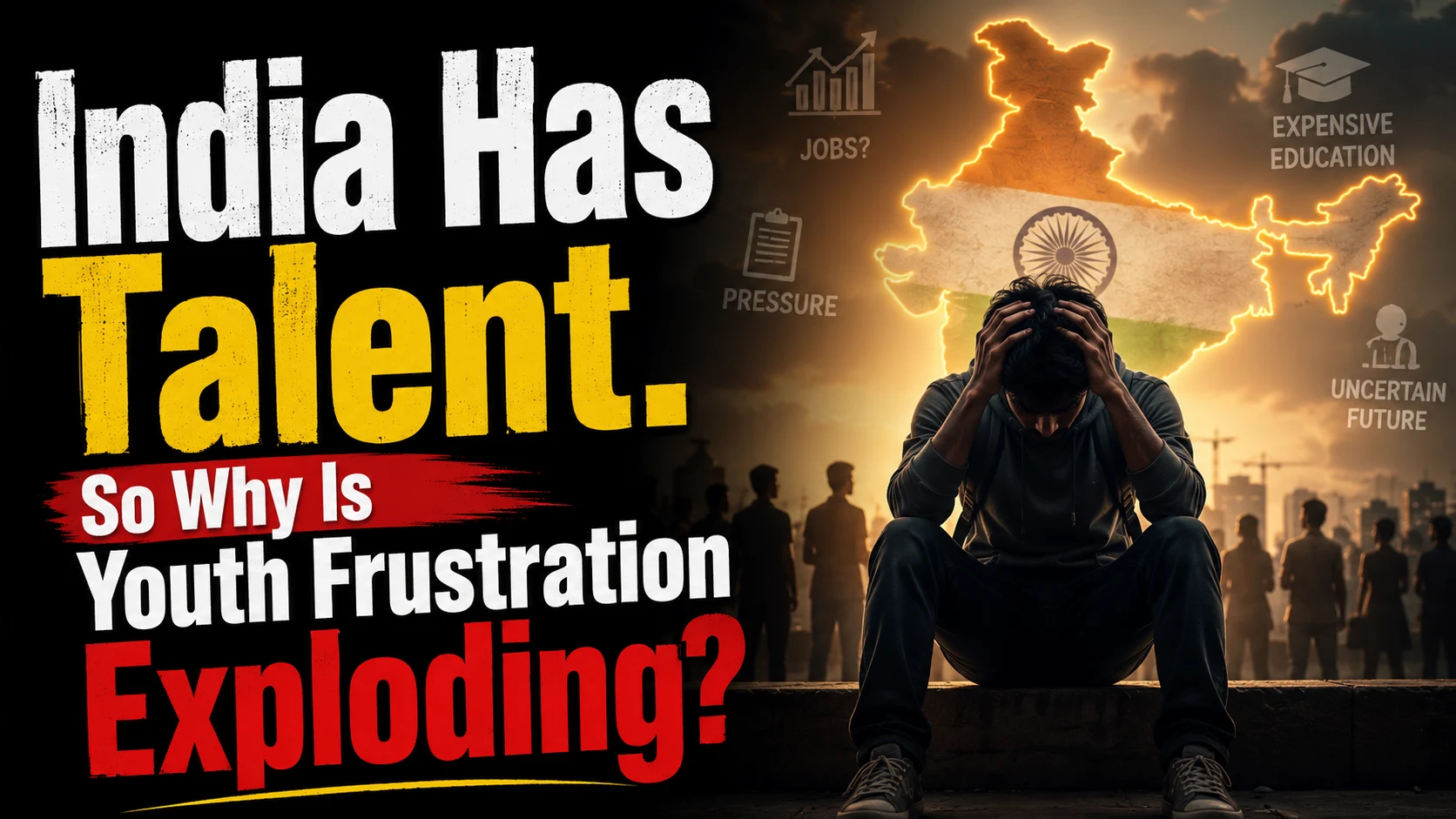
In the cramped reading rooms of Delhi’s Mukherjee Nagar and the hyper-competitive coaching hubs of Kota, millions of young Indians are chasing a rapidly shrinking dream. India is currently the fastest-growing major economy in the world, dazzling global investors with soaring stock markets and geopolitical clout. Yet, on the ground, a starkly different reality is unfolding: a swelling tide of youth frustration, marked by protests over canceled exams, a scramble for limited government jobs, and highly educated graduates settling for precarious gig work.
For ordinary citizens, this is not just an economic statistic—it is a crisis playing out in their living rooms. Families are pouring their life savings into degrees that no longer guarantee a livelihood, leaving an entire generation feeling betrayed by the promise of the “India growth story.”
If India has talent, ambition, and capital, why is the anger of its youth exploding? Uncovering the truth requires looking beyond political rhetoric and examining the deep, structural failures in education, employment generation, and institutional integrity.
A Crisis of Jobless Growth
At the heart of the youth frustration is a structural economic disconnect: headline GDP growth is not translating into mass employment.
According to the India Employment Report 2024, jointly published by the International Labour Organization (ILO) and the Institute for Human Development (IHD), India’s youth account for a staggering 83% of the country’s unemployed workforce. Even more alarming is the penalty for higher education: youth with secondary education or higher make up 65.7% of unemployed youth, a sharp increase from decades past.
This points to a fundamental flaw in the economic model. India leapfrogged traditional development pathways by relying heavily on the services sector (like IT and finance), which generates immense wealth but relatively few jobs.
- The IT Sector Ceiling: The technology sector employs roughly 5-6 million people directly—a fraction of the 8-12 million youth entering the workforce every year.
- The Agricultural Trap: As agriculture becomes less viable, millions of youth migrate to cities, only to find that the urban economy does not have the capacity to absorb them.
The Illusion of the Degree: Education vs. Employability
India has witnessed a massive expansion in higher education over the last two decades, with thousands of engineering and management colleges mushrooming across the country. However, quantity has completely cannibalized quality.
Industry reports repeatedly highlight a severe “skill mismatch.” Estimates suggest that nearly 50% of Indian graduates are unemployable in the modern corporate sector without extensive retraining. The education system remains stubbornly anchored to rote learning, failing to equip students with critical thinking, digital fluency, or practical vocational skills.
Consequently, the country is witnessing an influx of overqualified youth taking up low-paying, informal jobs. It is now common to find engineers and post-graduates working as delivery partners for food aggregators or applying for entry-level clerical positions in the railways—roles that require only a 10th-grade qualification.
Paper Leaks and Systemic Distrust
When the private sector fails to provide secure employment, youth naturally pivot to the government sector. This has birthed a massive, multi-billion-dollar coaching industry dedicated to cracking government exams like the UPSC, SSC, and railway recruitment tests.
However, the institutional machinery tasked with conducting these exams is cracking under pressure. Recent years have seen a relentless series of exam cancellations and paper leaks across multiple states and at the central level, most notably the controversies surrounding the NEET (National Eligibility cum Entrance Test) and state police recruitment exams.
The impact of these institutional failures is devastating:
- Shattered Meritocracy: When exam papers are sold to the highest bidder, honest candidates lose faith in the fairness of the system.
- Stolen Years: Candidates often spend 3 to 6 years of their prime youth preparing for these exams. A single leak or cancellation sets them back financially and psychologically.
- Erosion of Trust: The recurring inability of bureaucratic bodies to conduct secure exams highlights a deep-seated administrative apathy, leading directly to street protests and clashes with law enforcement.
The Missing Manufacturing Engine
Historically, economies like China, South Korea, and Taiwan pulled millions out of poverty and stabilized their societies through labor-intensive manufacturing. India’s manufacturing sector, however, has stagnated at around 14-16% of GDP for decades.
While initiatives like “Make in India” and Production Linked Incentives (PLI) have made inroads in sectors like electronics and mobile assembly, they have not yet created the massive, blue-collar job boom required to absorb rural migrants and semi-skilled youth. High logistics costs, complex labor laws, and a challenging regulatory environment continue to deter the scale of industrialization needed to solve the India job crisis.
The Road Ahead: Defusing the Demographic Time Bomb
India’s “demographic dividend”—the economic growth potential that results from a high working-age population—has a narrow expiration date. By the late 2030s, the population will begin to age. If the current employment crisis is not resolved, this dividend will rapidly mutate into a demographic liability, triggering deeper social unrest and rising inequality.
To change course, India requires urgent, structural reforms:
- Overhaul Institutional Integrity: Exam-conducting bodies must be fortified with blockchain technology and severe penal frameworks to guarantee zero-leak environments, restoring faith in merit.
- Pivot to Vocational Training: India must emulate models like Germany’s dual education system, deeply integrating apprenticeships and vocational training with formal schooling, erasing the societal stigma attached to blue-collar expertise.
- Empower MSMEs: Micro, Small, and Medium Enterprises are the true engines of job creation. They need aggressive credit support, reduced bureaucratic red tape, and tax incentives to scale up and hire locally.
The Bottom Line
India’s youth are not asking for freebies; they are demanding a fair playing field and the dignity of a reliable paycheck. The exploding frustration on the streets is a symptom of a much deeper disease: an economic architecture that celebrates billionaires while sidelining builders.
If India is to truly claim the 21st century as its own, it must stop treating its youth as political vote banks and start treating them as its most critical, and currently most squandered, asset. Time is running out, and the patience of the young has already worn thin.
Also Read The 50-Million Backlog: Is India’s Justice System Built Only for the Rich?