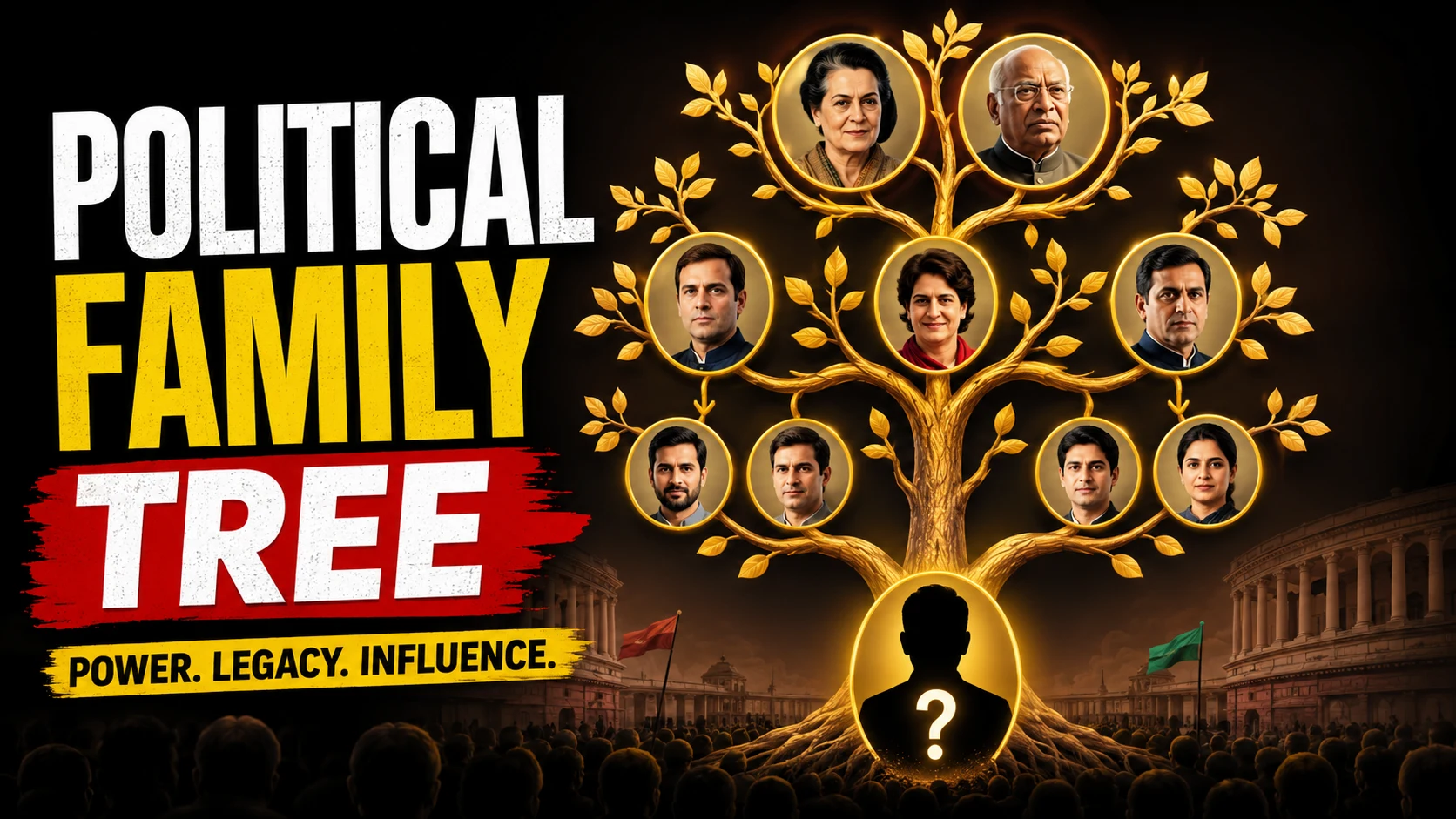
In the world’s largest democracy, the ballot box is designed to be the ultimate equalizer. Yet, a closer examination of India’s political landscape reveals a system that often operates more like a network of feudal fiefdoms than a modern meritocracy. When investigative journalists and civic tech researchers map out political family tree graphics, the resulting visualizations expose an uncomfortable reality: political power in India is overwhelmingly inherited. This entrenched dynastic politics restricts the entry of ordinary citizens into governance, turning public office into a generational heirloom and fundamentally altering how policies are shaped for 1.4 billion people.
The Scope of the Dynasty Web
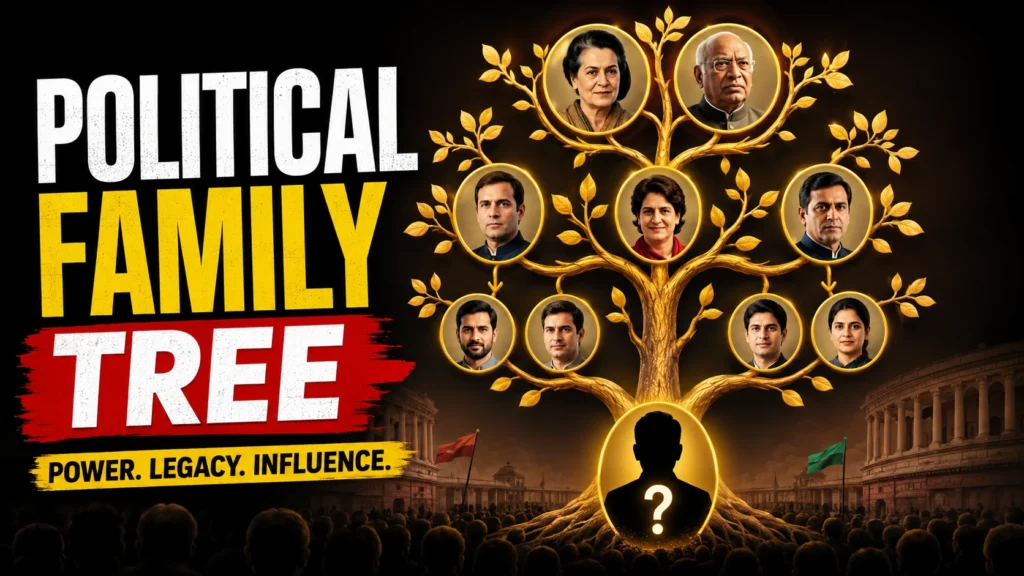
For decades, the public discourse around political dynasties in India was narrowly focused on a few prominent names at the national level, most notably the Nehru-Gandhi family. However, modern data journalism has shattered this limited perception. The visual mapping of political lineages demonstrates that nepotism is a pan-India, cross-party structural phenomenon.
According to sociological research and political data, approximately 29% to 31% of Indian Members of Parliament (MPs) owe their positions, directly or indirectly, to familial ties with established political figures. This dynastic grip extends from the Lok Sabha down to state legislative assemblies (MLAs) and even local municipal corporations.
- National Parties: While the Indian National Congress is historically synonymous with dynastic leadership, the ruling Bharatiya Janata Party (BJP)—despite its strong ideological stance against nepotism—also fields a significant number of second and third-generation politicians across various states.
- Regional Powerhouses: In many states, regional parties are entirely controlled by single families. The Dravida Munnetra Kazhagam (DMK) in Tamil Nadu, the Samajwadi Party (SP) and Rashtriya Janata Dal (RJD) in the Hindi heartland, the Thackerays in Maharashtra, and the Abdullahs in Jammu & Kashmir operate largely as family-run political enterprises.
Why Do Political Families Dominate?
The persistence of dynastic politics in India is not merely a cultural quirk; it is a profound structural flaw rooted in how elections are contested, financed, and managed. Research highlights several key institutional failures driving this trend:
- The “Winnability” Factor and Brand Recognition: In a highly populous country, building name recognition from scratch is incredibly difficult. A familiar surname acts as a pre-established political brand, offering an immediate electoral advantage that self-made, grassroots candidates struggle to match.
- The Astronomical Cost of Elections: Indian elections are among the most expensive globally. Political families have historically amassed the immense wealth, corporate backing, and centralized financing required to fund sprawling, multi-crore campaigns.
- Absence of Internal Party Democracy: Most Indian political parties lack transparent, democratic internal elections. Candidate tickets are distributed by high commands, who prefer to allocate them to the relatives of established leaders to maintain loyalty, rather than risking new, independent faces.
- Families as Political “Glue”: In an environment lacking strong institutional frameworks, family networks operate as a cohesive “glue” that unites factions and ensures trust within a political party. Bloodlines become a substitute for ideological discipline.
The Cost to the Indian Citizen
When political power is visualized through detailed political family tree graphics, it becomes immediately clear why certain constituencies experience stagnant socio-economic growth. The consequences of systemic nepotism are severe for the ordinary citizen:
- Stifling of Meritocracy: Talented youth, policy experts, and grassroots activists without a political lineage find the doors to governance firmly shut. This deprives the nation of fresh administrative ideas and perpetuates a ruling class detached from ground realities.
- Crony Capitalism: Dynastic politicians frequently share overlapping networks with business dynasties. This incestuous relationship can lead to the concentration of wealth and the passing of policies that favor inherited corporate empires over equitable economic development.
- Accountability Deficit: When leaders view their constituencies as inherited property, the pressure to perform diminishes. Loyalty to the family patriarch or matriarch supersedes accountability to the voter, resulting in institutional decay and poor public service delivery.
Visualizing the Truth: The Role of Data Journalism
In recent years, the use of interactive political family tree graphics by news organizations, think tanks, and civic researchers has fundamentally changed how voters perceive political nepotism. These data visualizations do what long political speeches cannot: they map out the intricate, undeniable web of cousins, spouses, in-laws, and offspring holding concurrent power across different levels of government.
By digitizing and visualizing these relationships, journalists have provided empirical proof that dynastic politics is not an anomaly but the central organizing principle of Indian politics. When a voter interacts with these graphics, they can clearly trace how a single family might control a local municipality, a state cabinet ministry, a seat in the national parliament, and a cooperative bank—all simultaneously. It strips away the ideological rhetoric of politicians and exposes the raw, biological consolidation of power.
The Path Forward: Can the System Be Reformed?
Dismantling a deeply entrenched culture of family politics requires more than just voter awareness; it demands aggressive institutional reforms to level the playing field.
- Mandatory Internal Party Democracy: The Election Commission of India could be legally empowered to mandate and closely monitor transparent, democratic elections within all registered political parties for leadership posts and candidate ticket distribution.
- State Funding and Expenditure Transparency: Democratizing campaign finance through partial state funding or stricter caps on corporate donations could reduce the financial barrier to entry, allowing meritorious, independent candidates to compete against well-funded dynastic heirs.
- Strengthening Grassroots Institutions: Empowering independent civil-society associations and local self-governments can create alternative pipelines for leadership that do not rely on high-command patronage.
Conclusion
The reality of Indian democracy is inherently complex—it is vibrant, chaotic, and deeply participatory, yet it remains structurally bottlenecked by bloodlines. The widespread use of political family tree graphics in modern journalism has successfully dragged this reality into the light, proving that nepotism respects no party lines, regions, or ideological boundaries. As India continues to assert itself as a rising global power, its internal political framework must evolve to match the ambitions of its 1.4 billion citizens.
Until the entry into politics is determined by a candidate’s vision, merit, and integrity rather than their surname, the true potential of India’s democratic promise will remain compromised.