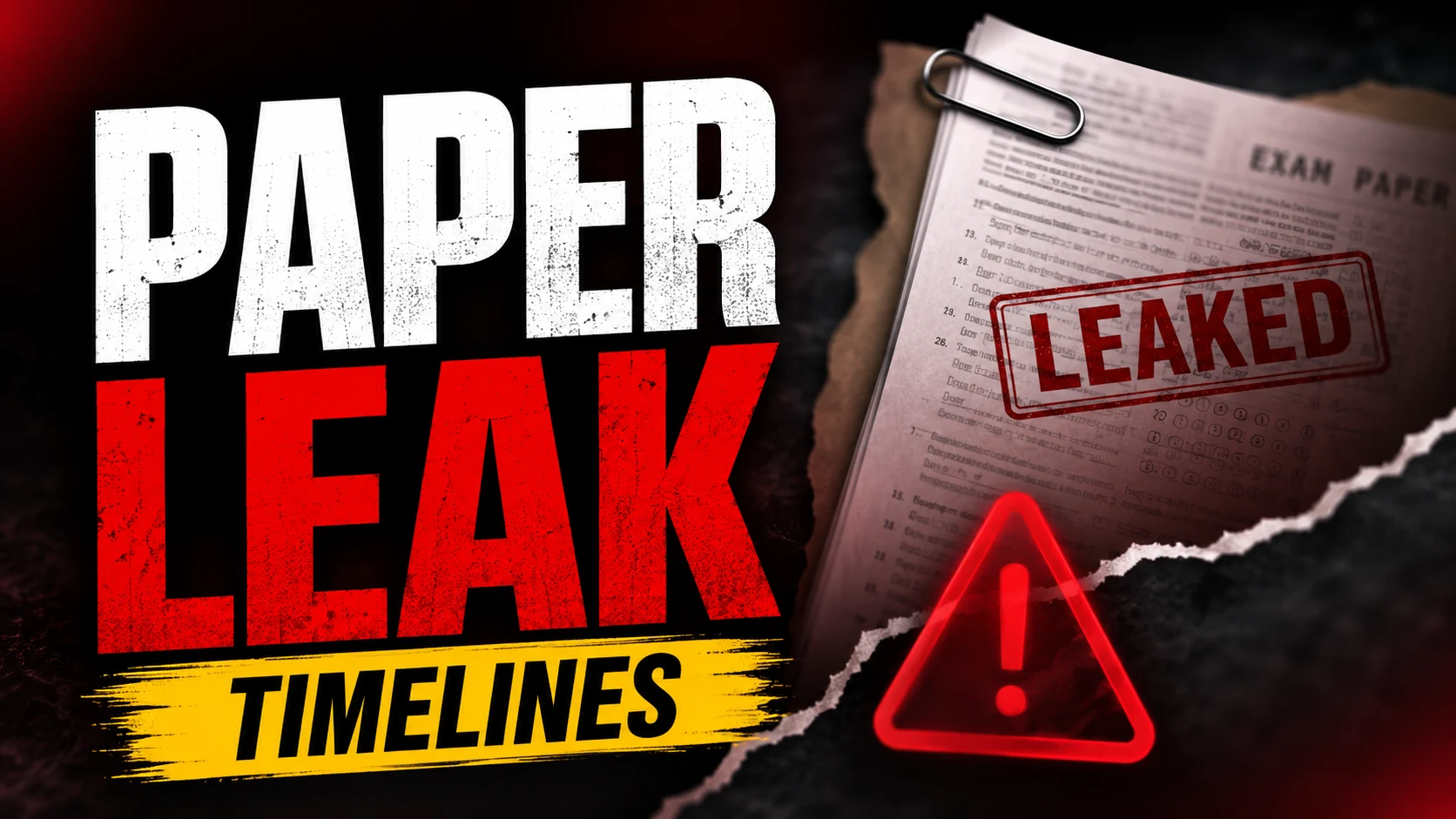
For millions of young Indians, clearing a competitive government or entrance examination is the ultimate ticket to upward mobility and economic security. Yet, this dream is increasingly being hijacked by a thriving shadow economy of exam mafias, compromised officials, and systemic vulnerabilities. Over the past five years, a staggering 41 documented exam leaks have occurred across 15 states, crushing the aspirations of nearly 1.4 crore (14 million) candidates.
This is no longer a string of isolated administrative lapses; it is a structural crisis. From nationwide controversies surrounding the NEET-UG medical entrance and the abrupt cancellation of the UGC-NET, to state-level fiascos like the UP Police Constable recruitment and Rajasthan’s REET, paper leak timelines expose a deeply compromised institutional machinery. Understanding this crisis requires looking beyond the immediate outrage and examining the root causes, the profound public impact, and the long-term consequences of a system that repeatedly fails its youth.
The Scale of the Crisis
To grasp the magnitude of the issue, one must look at the raw data. According to an extensive investigation by The Indian Express, these 41 leaks have disrupted recruitment processes for over 1.04 lakh government posts. The crisis cuts across political lines and geographical boundaries, affecting states governed by various political parties.
In a country where youth unemployment remains a pressing challenge, the competition for a limited number of secure positions is extraordinarily fierce. When a single recruitment drive for 60,000 police constables draws nearly 50 lakh applicants, the stakes are unparalleled. In this high-pressure environment, the sanctity of the examination process is the only thread holding public trust together. When that thread snaps, the resulting fallout is devastating both economically and socially.
Anatomy of a Leak: How the ‘Exam Mafia’ Operates
Paper leaks in India are rarely the work of lone actors. They are sophisticated, multi-crore illicit enterprises managed by well-oiled syndicates often referred to as the “exam mafia.” This shadow economy exploits weak links in the testing infrastructure.
The vulnerabilities are systemic and occur at multiple stages:
- The Printing and Packaging Phase: Leaks frequently originate at printing presses where security protocols are either outdated or deliberately bypassed by corrupt insiders.
- The Transit Pipeline: Question papers transported from treasuries to examination centers are often intercepted. Weak digital locks, compromised transport officials, and inadequate police escorts make this a prime vulnerability.
- The Coaching Center Nexus: Some unregulated coaching institutes act as brokers, purchasing leaked papers and selling them to desperate candidates for exorbitant sums, often running into millions of rupees.
- Technological Loopholes: While the shift to Computer-Based Tests (CBT) was meant to eliminate physical leaks, it has introduced new risks, such as server hacking, screen-sharing malware, and compromised examination center networks.
The lucrative nature of this black market, combined with previously weak legal frameworks, has meant that the reward for orchestrating a leak heavily outweighed the risk of prosecution.
The Human and Economic Toll
The consequences of compromised competitive exams in India extend far beyond delayed schedules. For the average aspirant—often hailing from a rural, low-to-middle-income household—preparing for these exams is a massive financial gamble. Families sell land, take high-interest loans, and exhaust their life savings to fund coaching fees and urban accommodation for their children.
When an exam is canceled due to a leak, this investment vaporizes. Furthermore, candidates lose irreplaceable time. Government recruitment exams often have strict age limits; a delay of two or three years can permanently age out an aspirant, ending their career prospects before they even begin.
Psychologically, the toll is immense. The recurrent invalidation of hard work breeds deep cynicism and despair. When merit is subverted by wealth and illicit access, a dangerous narrative takes root: that the system is fundamentally rigged against the honest citizen.
The Legislative Response: Will the 2024 Act Work?
Recognizing the escalating outrage, the Indian government introduced the Public Examinations (Prevention of Unfair Means) Act, 2024, which officially came into force in June 2024. The law attempts to shift the approach from reactive damage control to stringent deterrence.
Key provisions of the Act include:
- Harsh Penalties: Individuals caught facilitating leaks face imprisonment ranging from 3 to 10 years.
- Financial Ruin for Syndicates: The Act imposes fines of up to Rs. 1 crore on organized criminal syndicates and service providers involved in malpractices.
- Institutional Accountability: The law allows for the attachment of properties belonging to compromised institutions and holds directors of service providers personally liable.
While legal experts and policymakers have welcomed the Act as a necessary and formidable tool, legislation alone is insufficient. India does not suffer from a lack of laws, but rather from a deficit in implementation. The true test of the 2024 Act will be in the swiftness of police investigations, the independence of the prosecutors, and the willingness of the state to dismantle powerful nexuses that often enjoy local patronage.
The Road Ahead: Fixing the System
A permanent solution to India’s paper leak crisis requires an overhaul of how national and state bodies assess merit. Testing agencies must evolve from bureaucratic administrative bodies into modern, highly secure tech fortresses.
Reforms must include independent, third-party security audits of all testing agencies before every major exam cycle. The reliance on private, poorly vetted service providers for conducting digital exams must be replaced by a robust, state-backed digital infrastructure. Furthermore, decentralizing the examination process—shifting from single, high-stakes mega-exams to standardized, multi-tiered assessments spaced throughout the year—can significantly reduce the pressure points that mafias exploit.
Conclusion
The persistent timeline of paper leaks in India represents a profound institutional failure that threatens the country’s demographic dividend. When the credibility of the state’s recruitment and educational apparatus erodes, it takes generations to rebuild. The enforcement of the Public Examinations Act 2024 is a vital first step, but it must be followed by relentless institutional reform, uncompromising transparency, and the dismantling of the entrenched exam mafias.
India’s youth are not asking for guaranteed success; they are merely demanding a fair starting line. If a rising economic power cannot guarantee the integrity of a question paper, it risks failing the very generation it relies on to build its future.