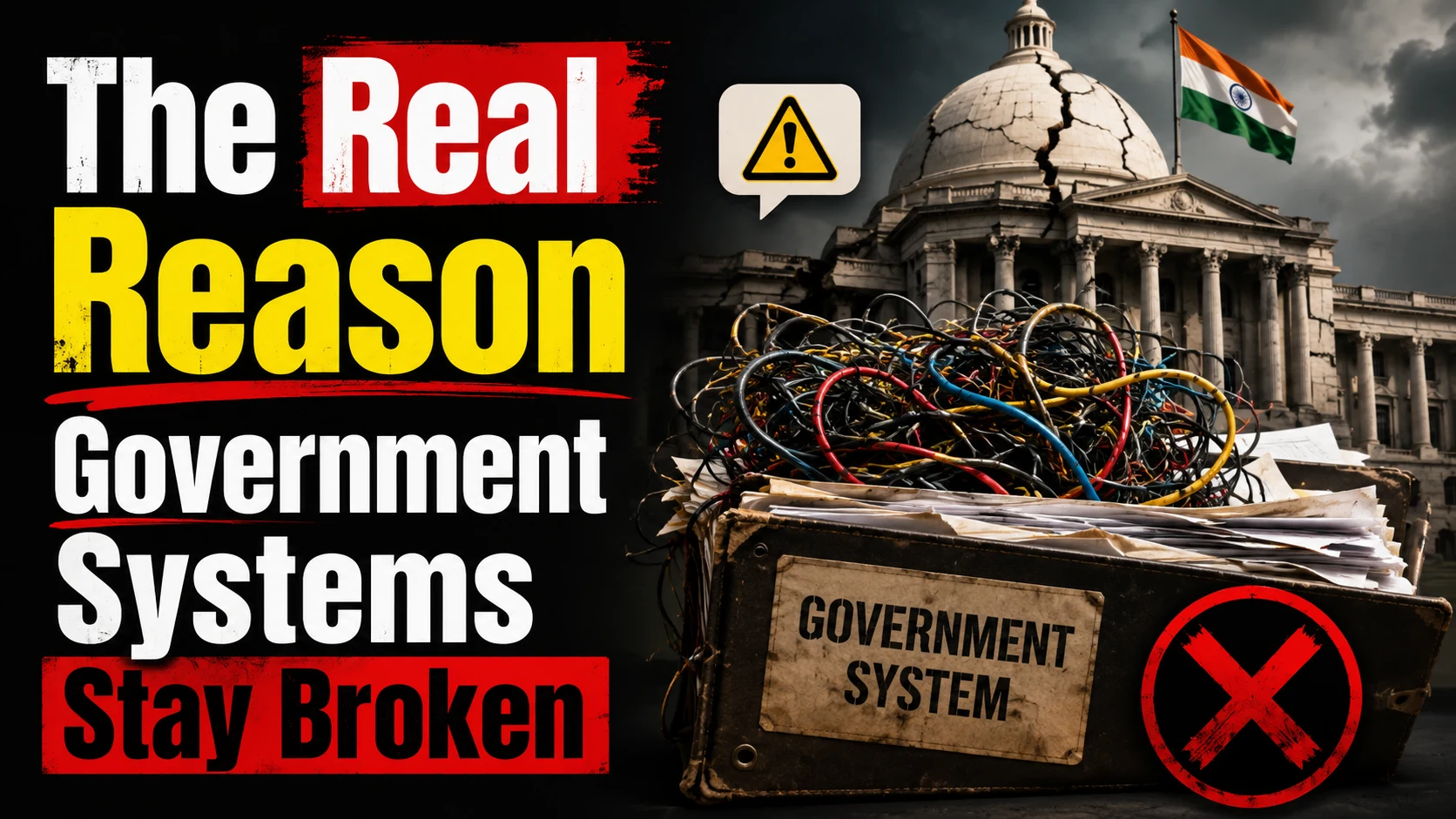
A newly inaugurated bridge develops cracks within months. A file for a widow’s pension gathers dust in a district office for years. To the frustrated citizen, these often look like isolated failures of a sluggish, underfunded government. But delve into the architecture of Indian bureaucracy, and a more unsettling reality emerges: these systems rarely fail by accident. They operate exactly as their internal incentives dictate.
For decades, political campaigns have been fought on the promise of “fixing the system” and improving public service delivery. Yet, regardless of the ideology in power, the core machinery of Indian governance—from municipal civic works to state-level welfare distribution—remains stubbornly inefficient.
To understand why government systems stay broken, one must look beyond political rhetoric and examine the structural reality of institutional paralysis, bureaucratic red tape, and misaligned incentives.
The Illusion of Incompetence
When a city’s drains overflow after an hour of rain, the public naturally blames administrative incompetence. However, investigative analyses into public infrastructure reveal that inefficiency is often a highly profitable equilibrium.
For the ordinary citizen, a potholed road is a hazard. For the ecosystem of local contractors, engineers, and political intermediaries, it is a recurring revenue stream. If a road is built to last twenty years, the contract is awarded only once. If it washes away every monsoon, it guarantees annual tenders, continuous budget allocations, and a steady flow of commissions. The system is not failing to build a good road; it is succeeding at sustaining a micro-economy.
The Transfer Industry and Short-Termism
A major structural driver of systemic government failure is the weaponization of bureaucratic transfers. According to multiple administrative studies, the average tenure of an Indian Administrative Service (IAS) officer in a specific posting often hovers between 12 to 16 months.
- No Long-Term Planning: Complex public problems—like overhauling a state’s public health infrastructure or cleaning a heavily polluted river—require years of consistent policy execution. A bureaucrat who expects to be transferred in a year has zero incentive to initiate a five-year systemic cleanup.
- The Compliance Culture: Instead of innovating, bureaucrats are incentivized to simply “keep the files moving” and avoid political confrontation.
- The Threat of Relocation: Honest officers who attempt to dismantle corrupt syndicates or enforce strict environmental regulations are routinely met with sudden, punitive transfers to obscure departments.
When survival in the civil service depends on political compliance rather than institutional performance, public service delivery inevitably collapses.
The Labyrinth of Overlapping Jurisdictions
If you want to understand why urban governance in India frequently breaks down, look at the organizational chart of any major Indian metropolis.
Taking Bengaluru or Mumbai as examples, a single neighborhood’s infrastructure is fractured across multiple, uncoordinated agencies. One civic body builds the road, a separate water board digs it up a week later to lay pipes, the electricity provider trims trees and leaves the debris, and a regional development authority plans a flyover right through it.
This fragmentation serves a distinct political purpose: plausible deniability. When multiple agencies share jurisdiction over a single civic issue, accountability vanishes. Ministers can blame the municipal commissioner, the commissioner blames the water board, and the water board blames the contractors. When everyone is responsible, no one is accountable.
The “L1” Trap: The Race to the Bottom
Another crippling institutional flaw is the rigid adherence to the “L1” (Lowest Bidder) procurement system. To prevent corruption and favoritism, government contracts for infrastructure, technology, and services are legally mandated to be awarded to the agency that quotes the lowest price.
While designed for transparency, this policy practically guarantees mediocrity.
- Contractors routinely underbid to win tenders, fully aware that the quoted amount is insufficient to deliver quality work.
- To maintain profit margins, they cut corners on materials, bypass safety protocols, and employ unskilled labor.
- Cost overruns and timeline extensions are then engineered later in the project lifecycle.
The state saves money on paper, but citizens pay the ultimate price through collapsing infrastructure, delayed public projects, and the need for perpetual repairs.
The Path to Genuine Institutional Reform
Breaking this cycle requires moving beyond superficial digitized portals and addressing the root architecture of the state machinery. Successive reports by the Second Administrative Reforms Commission (ARC) have laid out clear pathways, though political will remains the missing ingredient.
- Fixed Tenures for Civil Servants: Legally mandated minimum tenures for key administrative posts would allow officers to execute long-term visions without the looming threat of abrupt transfers.
- Unified Command in Urban Governance: Indian cities need empowered, directly elected Mayors overseeing unified metropolitan authorities, effectively ending the chaotic buck-passing between parastatal agencies.
- Value-Based Procurement: Shifting from the L1 (lowest cost) model to a Quality-and-Cost-Based Selection (QCBS) system for all public infrastructure would ensure that tenders evaluate the lifecycle durability of a project, not just its initial price tag.
- Outcome-Based Auditing: Government audits currently measure whether the allocated budget was spent according to the rules. Audits must shift to measuring actual outcomes—did the project solve the problem it was funded to fix?
Conclusion
The persistent failure of government systems in India is not a symptom of a lack of resources, nor is it merely an issue of outdated technology. It is the predictable outcome of an institutional architecture that rewards compliance over competence, fragmentation over unity, and short-term political optics over long-term structural integrity.
Until reforms target these underlying incentives, the machinery of the state will continue to spin its wheels—generating massive amounts of paperwork, consuming vast public funds, and leaving the ordinary citizen waiting in line. The ultimate question is not whether the government can be fixed, but whether those in power are willing to dismantle a broken system that currently serves them so well.
Also Read The 50-Million Backlog: Is India’s Justice System Built Only for the Rich?