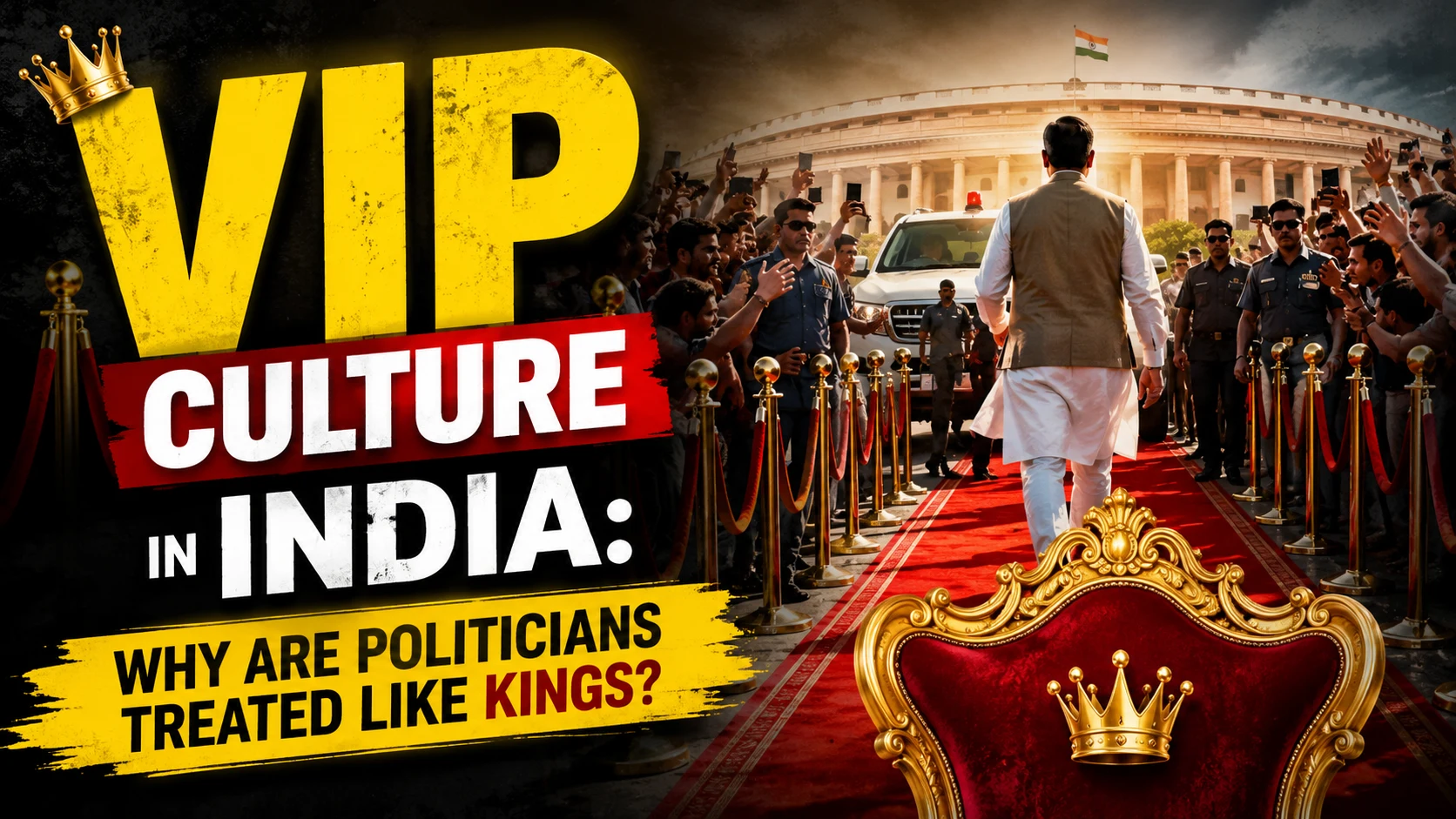
Picture a critical-care ambulance halted at a barricaded intersection, its siren drowned out by the roar of a dozen black SUVs speeding past. In 2017, the Indian government officially banned the colonial-era red beacon—the infamous lal batti—in a highly publicized attempt to dismantle the country’s deeply entrenched VIP culture. Yet, the core structures of extreme political privilege remain untouched, merely evolving from red beacons to wailing pilot vehicles, massive security cordons, and a stark daily divide between the governed and the governing.
For the ordinary Indian citizen, VIP culture is not just a philosophical grievance; it is an everyday infrastructural hazard. It represents a systemic inequality where the time, safety, and resources of taxpayers are routinely sacrificed to accommodate the unchecked entitlement of the political elite.
The Illusion of the “EPI” Promise
When the Prime Minister called to replace the “VIP” (Very Important Person) mindset with “EPI” (Every Person is Important) in 2017, it signaled a democratic shift. The optics were promising, but institutional realities rarely change overnight.
Today, political privilege is flexed through heavily armed convoys and Z-plus security details. In the Indian political ecosystem, security is rarely just about threat perception; it is the ultimate status symbol. Politicians, bureaucrats, judges, and even self-styled godmen actively lobby for higher tiers of state protection because a larger security detail directly translates to political clout. This visual display of state power over the masses continues to reinforce a patron-client relationship, directly contradicting the fundamental ethos of public service.
A Staggering Cost to Public Safety
The most severe consequence of this institutionalized VIP culture in India is its toll on the nation’s fragile law enforcement infrastructure. The human cost of political vanity is borne directly by the public security grid.
Consider the stark numbers:
- Severe Personnel Shortages: According to data from the Bureau of Police Research and Development (BPR&D), India’s actual police-to-population ratio stands at an alarming 153 police personnel per 100,000 citizens.
- Global Benchmarks Missed: This figure falls drastically short of the sanctioned strength of 196 personnel, and remains far below the UN-recommended standard of 222 police officers per 100,000 people.
- Misallocation of Resources: Despite this structural deficit, thousands of police officers are routinely pulled from active policing, investigations, and crowd control to serve as human shields for VIP convoys.
When police forces are stretched this thin, diverting critical manpower for non-essential VIP duties directly compromises local area policing, delays justice, and leaves ordinary citizens vulnerable to rising crime.
When Privilege Costs Lives: The Stranded Citizen
The real-world impact of VIP culture goes far beyond traffic annoyance; it frequently borders on human rights violations. Across Indian cities, instances of commuters being subjected to hours of delay due to arbitrary traffic halts for Chief Ministers or visiting dignitaries routinely make headlines.
The most tragic symptom of this bureaucratic apathy is the sight of ambulances stuck in artificial traffic jams. While emergency protocols technically mandate that medical vehicles be allowed to pass, ground realities often dictate otherwise. Overzealous local police, terrified of breaching protocol and facing punitive action from superiors, routinely freeze entire arterial routes. A system that forces a dying patient to wait so a politician can save five minutes of commute time is indicative of a profound democratic deficit.
Glimmers of Institutional Reform
While the national picture remains grim, civic pushback and localized administrative experiments offer a blueprint for dismantling this systemic inequality.
A few states are slowly experimenting with alternative models to balance security requirements with public convenience:
- The Emergency-Priority Model (Karnataka): Following public outrage over delayed ambulances, authorities in Karnataka strictly directed traffic police to prioritize emergency vehicles irrespective of VIP movement. The state also restricted the use of escort vehicle sirens, relying instead on wireless communication.
- The No-Preferential-Access Model (Aizawl): In Mizoram’s capital, traffic discipline supersedes VIP status. The city reduces disruption by avoiding preferential road access altogether, proving that predictable road behavior can manage congestion without forcing the city to a standstill.
Conclusion: Dismantling the Colonial Hangover
The persistence of VIP culture in India points to a broader crisis of governance. It is a colonial hangover—the babu mindset—repackaged for a modern electoral democracy. When leaders require a fortress of taxpayer-funded security to navigate the very constituencies they claim to represent, it signifies a deep disconnect from grassroots realities.
True reform will require more than banning sirens or removing beacons. It requires statutory guidelines that strictly limit state-funded security to genuine, intelligence-backed threat assessments, rather than political rank. It requires legislative accountability that penalizes the obstruction of emergency services by state actors.
Ultimately, a mature democracy cannot function like a feudal state. Until the Indian political class learns to wait in traffic like the people who elect them, the promise that “every person is important” will remain nothing more than a well-marketed slogan.
Traffic disruption and delayed emergency services due to VIP movement in North India
This news report captures the on-ground reality of major intersections being completely blocked for political convoys, demonstrating the direct impact this protocol has on emergency medical transport.
Also Read The Integrity Penalty: Why Honest Officers Rarely Survive India’s Bureaucratic Maze