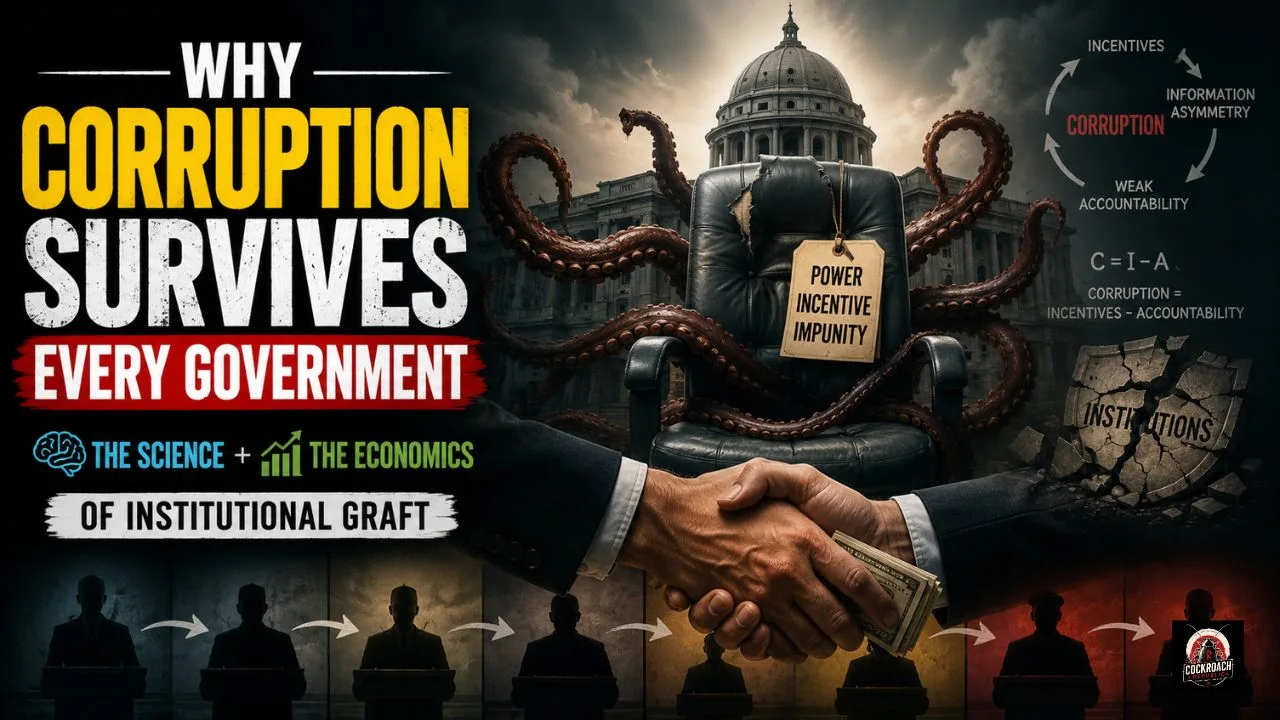
Every few years, citizens across democracies vote out governments on the promise of a cleaner, more transparent system, yet the shadow of public graft remains stubbornly untouched. For the ordinary citizen—who faces the daily friction of paying a bribe for a basic license, or watches tax money vanish into crumbling infrastructure—the question is agonizing: why does corruption survive every political revolution?
The answer, according to emerging neuroscientific research and global institutional analysis, is that we have been diagnosing the disease incorrectly. Corruption is not an episodic moral failure of a few “bad apples.” It is a highly rational, biologically grounded, and structurally embedded operating system.
Here is the deeper reality of why public graft outlives political change, and why traditional anti-corruption campaigns are fundamentally destined to fail.
The Informal Market for Public Office
To understand why corruption persists, we must look beyond political rhetoric to the structural mechanics of administration. According to the India Corruption Research Report (ICRR) 2025, the challenge confronting developing nations is fundamentally institutional, rooted in policy distortions and governance breakdowns.
Recent research published by Cambridge University Press (2026) highlights a critical mechanism: the “informal market for public office.” This invisible economy operates on a simple, ruthless logic:
- The Grand-Petty Link: Senior officials allocate highly desirable, lucrative administrative assignments to street-level bureaucrats in exchange for bribes, political loyalty, and deep-pocketed connections.
- Cost Recovery Logic: Once a street-level bureaucrat purchases their posting, they view rent extraction (bribe-taking from ordinary citizens) not as a crime, but as a legitimate way to recover the “costs” of securing their assignment.
- System Reproduction: Prosecuting a single official removes only one player, leaving the underlying market structure entirely intact.
When citizens interact with a corrupt local official, they are actually dealing with the bottom tier of a massive, well-organized pyramid of systemic cost recovery.
ALSO READ The ₹28 Lakh Crore Question: Where Does India’s Tax Money Actually Go?
The Neural Foundation of Bribery
While institutions create the opportunity for corruption, brain science explains why individuals yield to it. Groundbreaking neurocomputational research reveals that corruption has undeniable biological and cognitive underpinnings.
Scientists have identified specific regions of the human brain that dictate corrupt behavior:
- Right Dorsolateral Prefrontal Cortex (rDLPFC): This region causally modulates bribe-taking. Disrupting its function makes power-holders measurably more willing to accept tempting bribes.
- Anterior Insula: This area encodes the psychological and moral “cost” of conniving with a fraudulent briber.
- Right Temporoparietal Junction (rTPJ): Responsible for representing the harm brought to third parties—such as the public.
This research proves that when the rDLPFC is disrupted (for example, via transcranial direct current stimulation, or tDCS), participants become more willing to take bribes as the offer value increases. This is a causal neural mechanism, meaning the decision to accept a bribe is a complex calculation of risk, reward, and moral cost processed by the brain’s circuitry, not merely a flaw in character.
Systemic Enablers: Why the Ecosystem Protects Itself
Beyond the human brain, institutional environments are often perfectly tailored to nurture corruption. Data from the International Monetary Fund (IMF) and various government evidence papers identify clear systemic enablers that cross geographical and ideological boundaries:
- Excessive Discretion and Weak Accountability: Corruption thrives where centralization of power in the executive gives elites too much unchecked authority, while transparency mechanisms remain effective only on paper.
- Unrealistic Remuneration: In many systems, official salaries are set far below the actual cost of running a government office or maintaining a standard of living, forcing a reliance on “gray income.”
- Judicial Delays: Cumbersome rules, archaic procedures, and a lack of swift, decisive punishments mean the risks of engaging in corruption remain incredibly low. In many developing nations, the police and judiciary themselves are frequently ranked among the most corrupt institutions.
- Political Patronage: Systems that prioritize loyalty and dynastic connections over competence naturally breed environments where unchecked political-financial networks can thrive.
ALSO READ India’s Political Dynasties: Do Powerful Families Still Shape the World’s Largest Democracy?
The Illusion of Anti-Corruption Campaigns
History tells us that top-down crackdowns rarely cure the underlying disease. A classic historical example can be found in Ming Dynasty China. The empire’s system was structurally designed to produce corruption. Low official pay kept the bureaucracy affordable for the state, while “gray income” kept the local government functioning.
The empire knew this, tolerated it, and ultimately depended on it. As historians note, this was not a flaw; it was how the system operated. When Emperor Yongzheng attempted to formalize this gray revenue to clean up the system, new informal channels simply grew back within decades.
The problem was never morality. It was arithmetic. Today’s high-profile anti-corruption campaigns often fail for the exact same reason: they treat the symptom (the individual) rather than the disease (the structural arithmetic of the bureaucracy).
The Road Forward: Dismantling the Market
As long as public systems are built on a foundation of low accountability, excessive bureaucratic discretion, and an informal market for desirable postings, corruption will remain the default state of governance.
The true solution is not found in electing a different set of politicians or launching aggressive, headline-grabbing prosecutions. It lies in dismantling the systemic market for public office. This requires radical institutional reform: minimizing bureaucratic discretion through digitization, unlinking political patronage from administrative transfers, ensuring judicial independence, and restructuring civil service compensation so that honest work is economically viable.
Ultimately, corruption is a symptom of wider governance dynamics. Until we redesign the architecture of the state to make honesty mathematically and institutionally sustainable, the system of corruption will continue to relentlessly reproduce itself. The tragedy of modern governance is not that corrupt individuals exist, but that we have built systems where they are guaranteed to thrive.
ALSO READ The Financial Literacy Gap: Why Indian Schools Fail to Teach Money Management