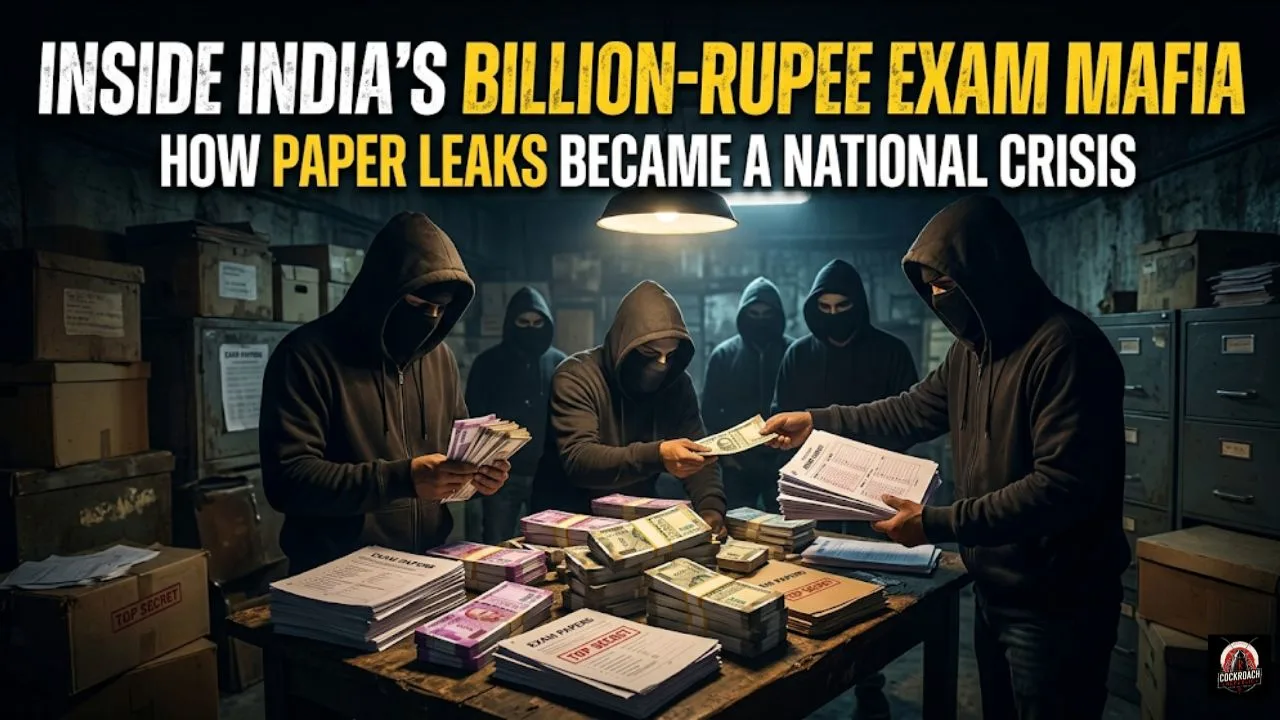
For millions of Indian youth, a government job or a medical college seat is the ultimate ticket to financial security and social mobility, paid for with years of grueling preparation. But in the shadows of this desperate pursuit, a highly organized criminal enterprise has turned these aspirations into a sprawling, billion-rupee black market. Over the last decade, exam paper leaks have metastasized from isolated incidents of cheating into a sophisticated national industry, fundamentally compromising the integrity of India’s examination system and hijacking the futures of over 6.5 crore candidates.
The crisis is not confined to a single region, testing body, or political administration. Since 2019 alone, investigations have documented at least 65 major exam paper leaks across 19 states. Behind these numbers lies a complex web of corrupt officials, opportunistic middlemen, and desperate families, all operating within a structurally vulnerable system.
The Scale and Economics of a Stolen Future
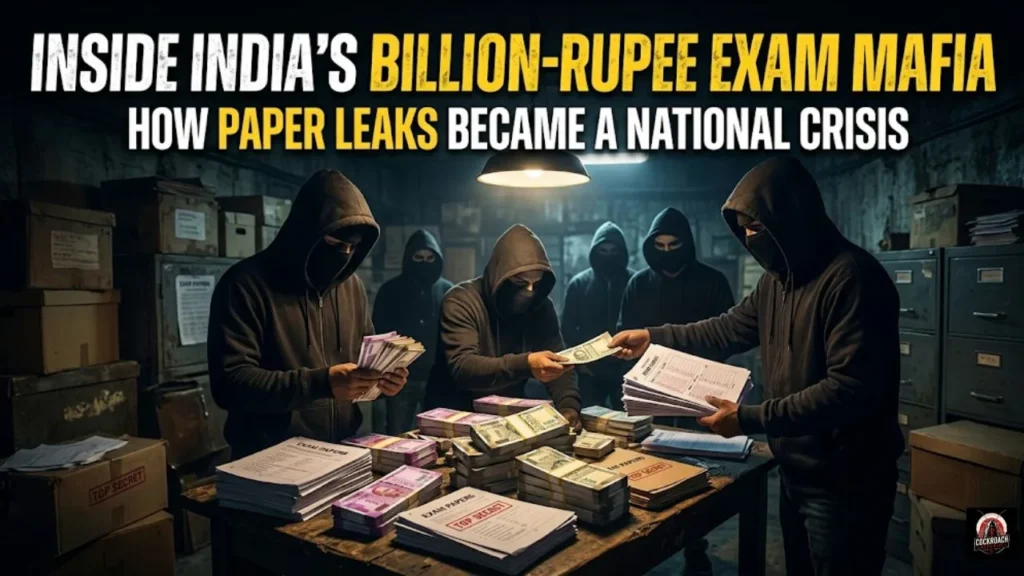
The paper leak industry operates on a simple economic principle: infinite demand chasing extreme scarcity. High-stakes exams like the National Eligibility cum Entrance Test (NEET) routinely see upwards of 2.4 million aspirants competing for roughly 100,000 MBBS seats. Similarly, state police or clerical exams attract millions of applicants for just a few thousand vacancies.
This desperation has created a highly lucrative, multi-tiered pricing model for stolen question papers.
- NEET-UG 2026: Investigations revealed that a leaked “guess paper”—which perfectly matched 90 Biology and 45 Chemistry questions—was sold across five states for ₹10 lakh to ₹25 lakh per copy.
- The Vyapam Scam: Madhya Pradesh’s infamous recruitment scandal, operating since the 1990s, grew into an estimated ₹6,300 crore ($1 billion) racket. Middlemen charged candidates anywhere from ₹15 lakh to ₹50 lakh for rigged results.
- State-Level Jobs: In the 2018 Gujarat Police Constable exam, leaked papers were priced at ₹5 lakh each, while candidates in other state board written tests have paid up to ₹15 lakh for guaranteed access.
What was once a localized crime has become a corporate-style enterprise. Over the past 10 years, 89 documented paper leak cases have forced 48 retests, bleeding public funds and crushing student morale.
4.1 Central (All-India) Exams
4.2 State Exams
These cases show:
- Leaks are not isolated but recurring across states and decades.
- Both central (NTA, UPSC, SSC, CBSE) and state boards are vulnerable.
How the Mafia Operates: A Sophisticated Supply Chain
The modern paper leak is rarely a crude smash-and-grab theft. It is an end-to-end supply chain relying on institutional insiders and encrypted digital distribution.
- The Origin Point: The compromise almost always occurs at logistical choke points. Printing press staff, transport vendors, or corrupt officials at exam centers break the seals of master copies early. In some cases, IT staff manipulate digital databases or answer keys.
- The Distribution Network: Brokers and middlemen connect racket leaders with willing buyers. Unscrupulous coaching centers frequently act as distribution hubs, masking the stolen documents as highly accurate “guess papers.” Digital channels like Telegram and WhatsApp allow these papers to cross state lines instantly.
- The Final Delivery: To prevent the paper from circulating freely and losing its premium value, mafias employ tight operational security. In recent NEET leaks, candidates were driven to secret locations a day prior, forced to memorize the answer keys overnight, and released just hours before the test.
- Impersonation and Manipulation: In the Vyapam scam, the mafia utilized an “engine-bogie” seating arrangement, placing weak candidates next to paid, highly qualified “dummies” who took the exam for them. Post-exam OMR sheet manipulation has also been widely documented.
Systemic Failures: Why the Racket Thrives
The success of these syndicates is largely due to systemic vulnerabilities rather than sheer criminal genius. India relies heavily on massive, synchronized pen-and-paper examinations. This requires transporting physical papers across thousands of kilometers to thousands of centers, handled by personnel who often lack rigorous background checks.
Historically, deterrence has been notoriously weak. Low conviction rates, protracted legal battles, and light sentencing created a low-risk, high-reward environment. Furthermore, the extreme stakes of the exams themselves mean that families view the ₹20 lakh bribe not as a crime, but as a high-return investment in their child’s lifetime earning potential.
The Human and Institutional Toll
The consequences of this industry extend far beyond compromised test scores. At its core, the paper leak mafia dismantles the promise of a meritocracy. When wealth and connections can purchase an MBBS seat or a police uniform, the quality of healthcare, law enforcement, and public administration inevitably degrades.
For the honest student, the psychological toll is devastating. Years of isolation, financial sacrifice, and intense study are invalidated overnight. Retests—of which there have been dozens—cost the exchequer crores in administrative and security expenses, diverting funds that could have been invested in actual educational infrastructure. More broadly, repeated cancellations erode public trust in institutions like the National Testing Agency (NTA), the UPSC, and state public service commissions.
The Crackdown and the Road Ahead
Recognizing the escalating crisis, the central government enacted the Public Examinations (Prevention of Unfair Means) Act, 2024, which came into force in June. The law specifically targets the organized syndicates, imposing harsh penalties of five to ten years in prison and fines up to ₹1 crore for paper leak gangs, making the offenses cognizable and non-bailable.
Investigative agencies like the CBI and state Special Task Forces are increasingly tracking the money trails, discovering advance payments of ₹30,000 just to “book” a paper. However, punitive laws alone cannot dismantle an industry fed by systemic desperation.
Educational and security experts argue that structural reforms are urgently needed:
- Technological Upgrades: Implementing end-to-end encrypted digital distribution to centers, shifting to Computer-Based Tests (CBT), and embedding unique, traceable watermarks on physical papers.
- Procedural Tightening: Utilizing GPS-tracked logistics, restricting master-copy access to a bare minimum, and conducting stringent audits of third-party vendors.
- De-escalating the Stakes: Moving away from single, make-or-break annual exams toward multiple attempts per year, thereby reducing the leverage the mafia holds over panicked students.
Until the examination infrastructure patches its logistical vulnerabilities and the system addresses the apocalyptic scarcity of opportunity, the black market will continue to find a way. Laws may punish the perpetrators, but it is the structural integrity of the system that must ultimately protect the aspirations of India’s youth.