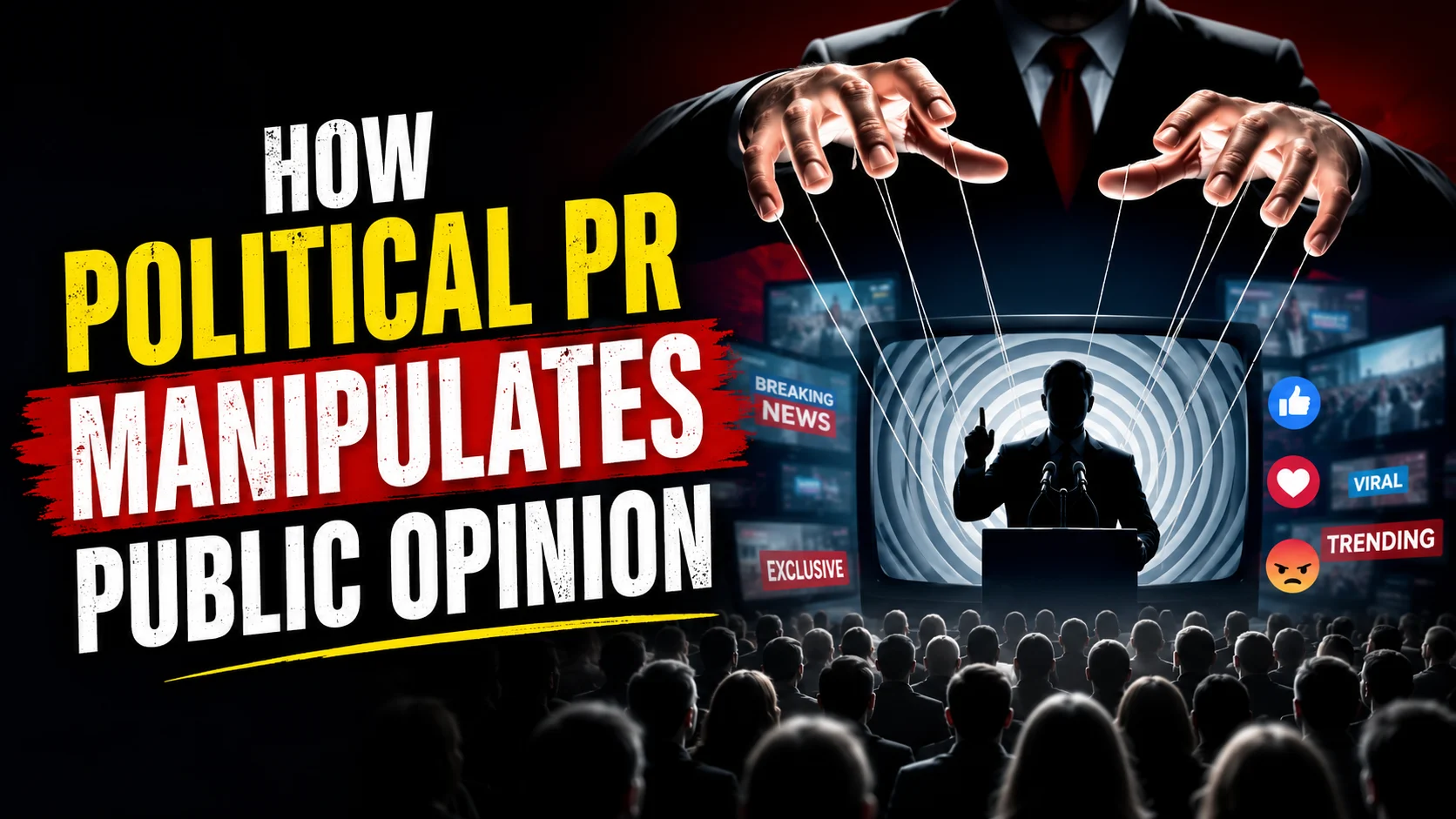
In modern democracies, elections are no longer won by grassroots canvassing alone; they are won in server rooms and corporate boardrooms. The manipulation of public opinion has evolved from traditional campaign promises into a multi-million-dollar industrial complex. Today, what citizens read, fear, and believe is increasingly manufactured by invisible political public relations (PR) machinery.
For the ordinary citizen, this invisible architecture of persuasion matters deeply. When political discourse is hijacked by engineered narratives, real-world issues like unemployment, healthcare infrastructure, and inflation are pushed to the margins. Voters are no longer treated as citizens to be served, but as data points to be triggered.
To understand the structural reality of Indian politics today, one must look beyond the politicians and examine the corporate consultants who script their every move.
The Architecture of Manufactured Consent
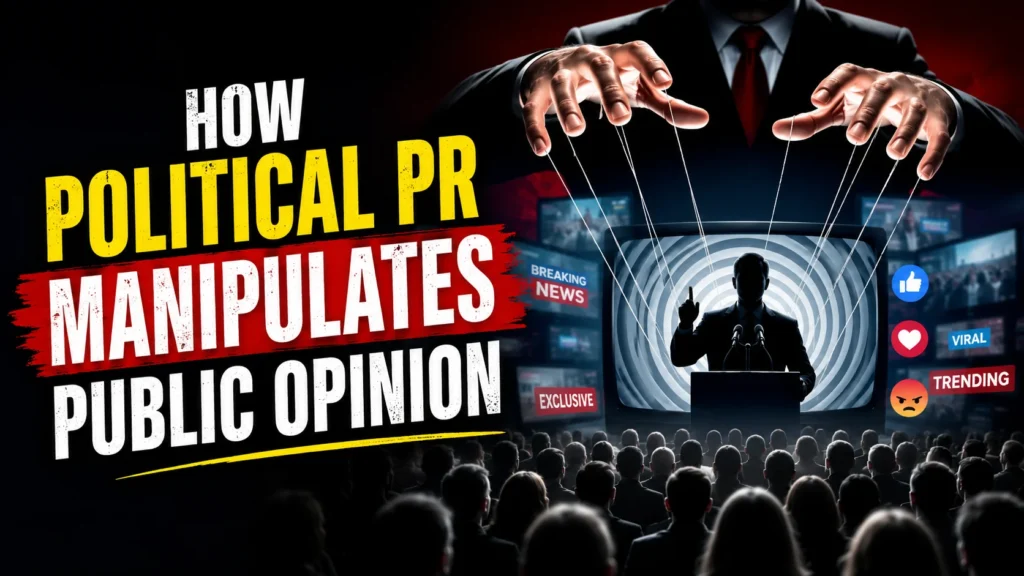
Historically, political communication in India was public and accountable. Parties held rallies, released manifestos, and debated on television. Today, the most influential political communication happens in the shadows, driven by highly paid political consultancies and PR firms.
These agencies operate on a corporate model. They recruit graduates from premier institutions—IITs, IIMs, and top law schools—to run “war rooms.” Their mandate is simple: define the political narrative, amplify the leader’s image, and neutralize the opposition.
However, this professionalization has a dark side. Because these PR firms are strictly results-driven, they frequently resort to ideological polarization. If data suggests that anger and fear generate higher engagement than policies on rural agricultural reform, the PR machinery will flood the digital ecosystem with divisive, emotionally charged content.
The Tools of the Trade: Fear, Deepfakes, and Micro-Targeting
Political PR no longer relies on blanket advertising. It relies on behavioral psychology and data harvesting. The mechanisms used to shape public opinion are sophisticated and largely unregulated:
- Dark Social and WhatsApp Weaponization: Unlike public platforms like X (formerly Twitter) or Facebook, WhatsApp is encrypted and impenetrable to fact-checkers. PR agencies create tens of thousands of hyper-local groups, dripping a daily dosage of carefully crafted propaganda, selective history, and fabricated news directly into voters’ phones.
- Astroturfing: This is the deceptive practice of presenting an orchestrated PR campaign as a spontaneous, grassroots public reaction. When a specific hashtag trends nationally, it is rarely organic. It is usually the result of automated bots and paid influencers artificially amplifying a narrative to create the illusion of public consensus.
- Synthetic Media (Deepfakes): Following the 2024 general elections, the deployment of AI-generated audio and video has become a standard, yet deniable, tool. PR cells use deepfakes not just to mock opponents, but to create fabricated audio leaks that destroy reputations overnight.
- Outrage Engineering: Algorithms reward engagement, and nothing drives engagement like outrage. PR agencies deliberately plant controversial statements or out-of-context video clips to dominate the 24-hour news cycle, distracting the public from pressing governance failures.
The Institutional Failure of Oversight
The rapid industrialization of political PR has exposed massive institutional and regulatory voids in India’s democratic framework.
First, the Election Commission of India (ECI) operates on a regulatory framework designed for the 20th century. While there are strict caps on how much a candidate can spend on jeeps, loudspeakers, and posters, the millions spent on third-party PR agencies, data analytics firms, and meme-creators operate in a vast legal gray area. Because these agencies act as independent corporate entities, their digital spending is notoriously difficult to audit and link directly to a candidate’s statutory expenditure limits.
Second, the lack of robust data protection laws allows political parties and their PR affiliates to harvest voter data with impunity. Voter rolls are frequently cross-referenced with welfare beneficiary lists, caste demographics, and consumer habits to create invasive psychological profiles of specific neighborhoods.
The Cost to Democracy: Polarization Over Policy
The most devastating consequence of PR-driven politics is the erosion of intellectual honesty in public life.
When governance is reduced to event management and headline manipulation, long-term policy formulation suffers. Governments become incentivized to launch schemes that look good on social media infographics rather than those that require years of quiet, unglamorous administrative work.
Furthermore, this continuous cycle of PR manipulation fundamentally damages social cohesion. To keep their clients constantly relevant, PR agencies must invent constant threats. This results in the relentless targeting of minorities, civil society, or dissenting voices, transforming political competitors into national enemies. The institutional bureaucracy—police, investigative agencies, and civil servants—often finds itself pressured to align with these manufactured public sentiments, compromising the neutrality of the state.
Reforms and the Future Outlook
Reclaiming public opinion from shadow PR machinery requires immediate, systemic reform:
- Auditing the Shadow Campaigns: The ECI must expand its definition of election expenditure to include all third-party consulting, data mining, and digital proxy campaigns. Financial transparency regarding who funds these agencies is paramount.
- Algorithmic Accountability: Social media platforms must be legally compelled to provide transparency over political micro-targeting. Voters have the right to know why they are seeing a specific political advertisement and who paid for it.
- Mandatory Labeling of AI Content: With the rise of synthetic media, any political communication using AI-generated content must carry a mandatory, unremovable watermark.
A Thoughtful Conclusion
The machinery of political PR has proven that public opinion is no longer something a government must earn through good governance; it is something that can be bought, manufactured, and distributed at scale. While technology has given ordinary citizens unprecedented access to information, it has given political entities unprecedented access to our psychological vulnerabilities.
Unless regulatory institutions modernize to confront the reality of digital manipulation, elections will cease to be a contest of ideas. Instead, they will remain a battle of algorithms—won by the agency with the best data, the deepest pockets, and the fewest moral constraints. Democracy dies not just in the dark, but in a blinding flood of manufactured light.
Also Read The Integrity Penalty: Why Honest Officers Rarely Survive India’s Bureaucratic Maze