We build statues for honest leaders and script blockbuster movies about crusading civil servants. Yet, within the quiet corridors of government offices, public sector units, and large corporate institutions, absolute integrity is rarely a survival trait. For decades, the structural reality of administration has harboured a quiet truth: honesty, when unaccompanied by immense political or network capital, is often a career hazard.
For the ordinary citizen, this is not just an abstract administrative debate. When an honest engineer is transferred for refusing to clear a substandard bridge contractor, the consequence is a collapsed overpass. When an auditor is sidelined for flagging financial anomalies, public tax money vanishes into systemic black holes. The attrition of honest officers directly translates into failing public infrastructure, delayed justice, and the normalisation of everyday corruption.
To understand why the system ejects its most principled actors, we must look beyond individual morality and examine the mechanics of institutional governance, bureaucratic incentives, and the weaponisation of rules.
The Clash Between Rules and “Pragmatism”

Bureaucratic systems are theoretically designed to be fair, operating on rigid rules and due process. However, the lived reality of governance is incredibly messy. Across government departments, daily operations often rely on entrenched “work-arounds”—informal shortcuts used to bypass red tape and keep the machinery moving.
When an honest officer enters this ecosystem and insists on strict adherence to the rulebook, they are rarely viewed as a safeguard. Instead, peers and political executives often label them as “obstructionist,” “slow,” or “impractical.” Decision-makers, driven by election cycles, budget deadlines, and the pressure for quick wins, demand speed. In this high-pressure environment, an officer who pauses a project to conduct ethical due diligence becomes a speed breaker on the highway of political expediency.
The Invisible Networks of Power
Merit and honesty fight a lonely battle against networks built over decades. Institutions run on formal hierarchies, but they are governed by invisible networks of patronage, caste affiliations, shared cadre loyalties, and mutual favours.
Officers who refuse to play this invisible game find themselves fundamentally isolated. They lose access to crucial departmental intelligence, informal support, and, most importantly, top-cover protection when things go wrong. When a crisis hits, the system protects its own—those who have bought into the unwritten rules of mutual accommodation. The lone, uncompromising officer is easily cast as an outlier and becomes a convenient scapegoat for institutional failures.
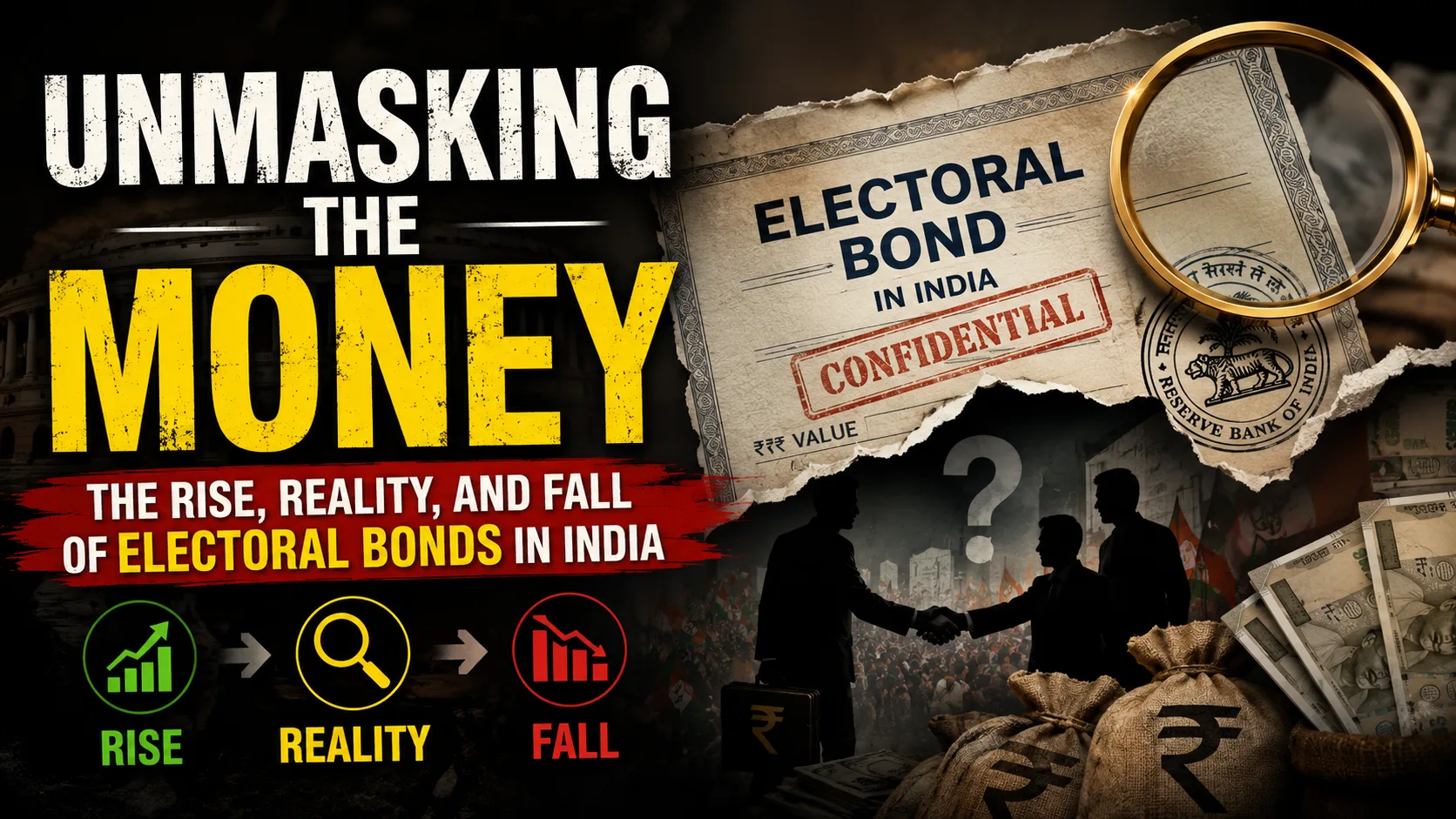
ALSO RAED Unmasking the Money: The Rise, Reality, and Fall of Electoral Bonds in India
Misaligned Metrics and Punitive Transfers
One of the greatest systemic failures in governance is how performance is measured. Key Performance Indicators (KPIs) in public service heavily reward outputs: funds disbursed, projects inaugurated, and timelines met. However, ethical diligence—such as risk mitigation, preventing a scam, or ensuring transparent bidding—is invisible, unquantifiable, and ultimately unrewarded.
When officers do step out of line to blow the whistle or block a compromised deal, the retaliation is swift and legal. The most common tool of administrative punishment is the “punitive transfer.” It is not uncommon in the Indian bureaucracy to see upright civil servants transferred 40 to 50 times in a 30-year career.
These constant uprootings serve a dual purpose: they remove the immediate “obstacle” from a lucrative posting, and they send a chilling message to the rest of the cadre. The personal cost—disrupted family life, stalled promotions, and social isolation—is a heavy tax that deters the majority from speaking up.
The Ripple Effect: Policy Paralysis
The continuous marginalisation of honest officers creates a secondary, equally dangerous problem: policy paralysis. Watching their principled colleagues face harassment, inquiries, and endless transfers, the silent majority of bureaucrats adopt a strategy of extreme risk aversion.
To survive, officers simply stop making decisions. Files are pushed upward, cross-departmental committees are endlessly formed, and critical public projects stall. The system learns that doing nothing is safer than doing the right thing.
Re-engineering the System for Integrity
If India is to build resilient, world-class institutions, the burden of honesty cannot rest solely on the shoulders of individual martyrs. We must design systems that protect integrity rather than punish it.
- Redesign Incentives: Performance appraisals must measure and reward compliance, transparency, and the courage to prevent systemic failures, not just the ability to deliver rapid outputs.
- Strengthen Institutional Safeguards: The reliance on individual heroism must be replaced by robust institutional shields. This requires truly independent audit cells, functional whistleblower protection laws that guarantee anonymity, and strict limits on arbitrary executive transfers.
- Promote Distributed Leadership: Decision-making power should be decentralized. When accountability and approvals are shared across empowered teams rather than concentrated in gatekeepers, it becomes mathematically harder to pressure or marginalize a single honest actor.
- Visible Leadership: Culture follows the tone set at the top. Senior bureaucrats and political leaders must visibly role-model ethical choices, especially when they are politically inconvenient.
- Build Supportive Networks: Honest officers need institutional allies. Peer cohorts, civil society links, and independent media act as a vital safety net, reducing the personal risk of standing up to corrupt practices.
The Final Outlook
A thriving democracy cannot afford to treat honesty as an act of rebellion. The survival of principled officers is the most accurate barometer of an institution’s health. Until we bridge the gap between the values we preach in our training academies and the incentives we reward in the secretariat, the bureaucratic machinery will continue to grind down its best minds.
Systems are perfectly designed to yield the results they currently produce. If we want honest officers to survive, we do not need better heroes; we need better architecture.